
This article explains how Ecoinvent is integrated and used within Cozero, and how you can access its data. It also provides an overview of the core principles and structure of the Ecoinvent database to help you build a solid understanding of its main features and underlying concepts.
The Ecoinvent database contains more than 25,000 life cycle inventory datasets, covering a range of sectors - including building and construction, chemicals and plastics, energy, and more. At Cozero, we primarily provide Ecoinvent data for over 4,600 business activities in the following sectors:
- Purchase of raw materials and goods
Scopes 3.1 & 3.2 - Production goods & materials, Office goods, Capital goods
-> Upstream production of raw materials, intermediate goods, manufactured products and capital goods across sectors such as chemicals, metals, plastics, textiles, glass, food, forestry, paper, non-metallic minerals, and electronic items.
Typical application: accounting for emissions from purchased products based on procured weights. Larger machinery typically have data for single product units as well.
- Purchased logistics
Scopes 3.4 & 3.9 - Purchased logistics, Logistics of sold products
-> Freight transport across different modes such as road, rail, sea, air, and inland waterways; both upstream and downstream, enabling the estimation of transport-related supply-chain emissions.
Typical application: emissions from goods movement and third-party logistics measured in mass-distance units.
- Personnel travel
Scopes 3.6 & 3.7 - Business travel and Employee commuting
-> Travel and accommodation for professional and commuting purposes, including air, rail, road, and other modes of transport.
Typical application: estimating travel-related emissions using activity data expressed in distance or service units (such as room nights) for business trips and daily employee commuting.
The emission factors in the Ecoinvent database represent average production conditions within a specific geographical region, rather than company-specific or site-specific operations.
For example, Ecoinvent provides data for the average cast iron production in Europe, rather than for a particular producer or farm.
In addition, often datasets describe intermediate products — materials and components used in further manufacturing — rather than final consumer goods. As proxies for the accounting of purchased final products, these intermediate product emission factors are often acceptable if they cover the main impacts of the accounted product. However, for a truly accurate representation for final products, especially for product footprint calculations, additional treatment factors need to be used to fully reflect a product's emissions.
For example, the database includes data for cotton textile production, but not for t-shirts made from that textile. Additional treatment factors, such as bleaching and finishing of textiles, need to be used to fully reflect emissions for the final manufactured product.
Accessing Ecoinvent data
As a Cozero customer, you can access Ecoinvent emission factor data in two ways:
- Through Cozero’s partnership with Ecoinvent
Each client account includes 10 free emission factors which can be requested through your Customer Success Manager. If you need access to more than 10 emission factors, your Customer Success Manager can help you access and unlock additional data. - Using your own Ecoinvent license
If your organization already has an Ecoinvent license, Cozero can help import and integrate these as custom emission factors into your account.
Fundamentals of the Ecoinvent database
There are several configuration options when selecting data from Ecoinvent. In Cozero, the emission factors are based on 100-year global warming potential (GWP) values, calculated using the IPCC 2021 LCIA methodology.
Below, you’ll find explanations of three key concepts — time period, activity type and system model — along with details on how these are defined and applied in Cozero.
Understanding these elements will help you accurately interpret the emission factors and ensure proper comparison and use of the data.
- In Cozero, the validity year reflects the emission factor’s publication year, matching the start year defined in Ecoinvent.
- Activity types: represent a unit process of a human activity and its exchanges with the environment and with other human activities. The two most important types are production and market activities.
- Production activities: reflect the process of transforming raw materials and energy into a new product.
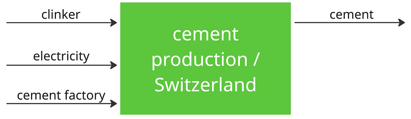
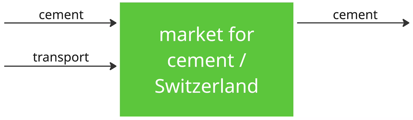
- Market activities: take an already transformed product or service and transfer it from the producer to the consumer.
- Which one should be used?
- Use the production factors when a purely production impact for a purchased material or service is required, for example when a raw material or a product is purchased directly from the supplier. These activities represent a cradle-to-gate boundary including raw materials and production impacts. It is important to ensure that any transportation impacts from the supplier are included in category 3.4.
- The market activities expand the cradle-to-gate boundary by including sector-average transportation impacts from the supplier to the consuming facility. These activities can be used if there is high uncertainty regarding transport activities upstream (eg., if products are not procured directly from the manufacturer but rather from distributors, or if transport data from suppliers to consuming facilities is missing).
- We recommend using production activities as a default selection whenever they are available and the products come straight from the manufacturer. In these cases, it is important to account for the transport activities from your suppliers to your facilities in the Cozero category “Purchased logistics”.
- Production activities: reflect the process of transforming raw materials and energy into a new product.
- Cozero uses Ecoinvent’s system model “Allocation, cutoff by classification”, or the cut–off system model, which aligns with the Greenhouse Gas Protocol Scope 3 Standard. This method specifies system boundaries for example for recycled materials and defines which impacts are included in each emission factor to account for emissions in a consistent way.
- Following this method:
- Products made from virgin materials carry all the production emissions required to obtain and transform raw materials.
- Recyclable products’ end of life treatment impacts are excluded, and the only waste treatment impacts come from transportation of the waste product to the treatment facility.
- For recycled materials used in the production of a new product, only the emissions from processing the material for reuse are counted. The emissions from the raw material’s original production are not included.
- This approach:
- Recognizes the benefits of recycling and the use of recycled materials
- Avoids double-counting emissions
- Gives a clear view of the real climate impact of using recycled materials.
- Example:
Recycled paper only bears the impacts of waste paper collection and the recycling process of turning waste paper into recycled paper. It is free of any burdens of the forestry activities and processing required for the primary production of the paper.
- Following this method:
Questions?
Our goal is to make sure you know what's happening with your emissions data. If you have any questions, concerns, or ideas, just reach out to us at support@cozero.io.