
Download your CSRD report in Cozero Share > Computed reports section.
A cornerstone of the European green transformation
In the last years, the European Union has been working intensely on the Corporate Sustainability Reporting Directive (CSRD), a major legislative enactment of the EU Green Deal. The CSRD is a “critical step towards the objective of placing sustainability reporting on an equal footing with financial reporting. Quality sustainability-related information is indeed key to transparency and decision-making.” (Patrick de Cambourg, Chair of the EFRAG SRB)
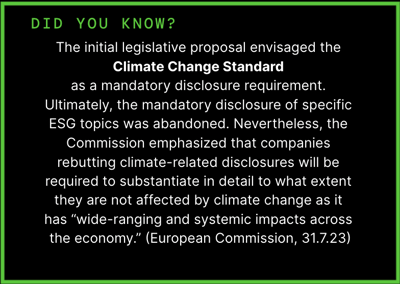
On July 31 2023, the commission adopted the ESRS, a first set of reporting standards. These general and sustainability-related disclosures were developed in cooperation with existing frameworks such as the Global Reporting Initiative (GRI), the Carbon Disclosure Project (CDP), the Task-Force for Climate-related Disclosures (TCFD), to ensure harmonization and comparability of sustainability disclosures. It is estimated that the CSRD will affect more than 50,000 companies based in the EU or performing activities on EU territory.
The CSRD's scope has narrowed significantly since its original adoption. In February 2025 the European Commission launched its "Omnibus" simplification package to reduce reporting burden and strengthen EU competitiveness. The resulting Omnibus I Directive entered into force in March 2026. It raises the thresholds to companies with more than 1,000 employees and above €450 million turnover — cutting the number of in-scope companies by around 80%, to an estimated 10,000 — streamlines the ESRS, and defers first reporting under the new rules to financial years starting from 1 January 2027, meaning the first reports are published in 2028 based on 2027 data.
The following article explains the scope, timeline and main features of the ESRS. It highlights how Cozero can support businesses in efficiently aligning with the CSRD. At Cozero, we believe that the CSRD goes beyond regulatory compliance; rather it needs to be considered as a strategic imperative for organizations to stay competitive on the way towards a low-carbon European economy.
Which companies are in scope and when will reporting be due?
- Large, EU-based companies with more than 1,000 employees and above €450 million net annual turnover (individually or on a consolidated basis for groups)
- Non-EU companies that generate a net turnover above €450 million in the EU, with an EU subsidiary or branch exceeding €200 million net turnover
- SMEs are no longer in scope, and certain EU and non-EU financial holding companies are exempted from consolidated reporting
- SMEs remain outside mandatory scope, but a Voluntary Standard for SMEs (VSME) is available; the Commission adopted the VSME Delegated Act on 19 July 2026. It can be expected to become the default basis for supplier data requests down the value chain.
- Value chain cap: companies below the 1,000-employee threshold that are asked for data by an in-scope customer can limit what they disclose to the VSME's voluntary datapoints
Timeline: the new scope applies from financial years starting 1 January 2027 onward (so first reports under the new rules land in 2028). Member States have until 19 March 2027 to transpose the directive into national law.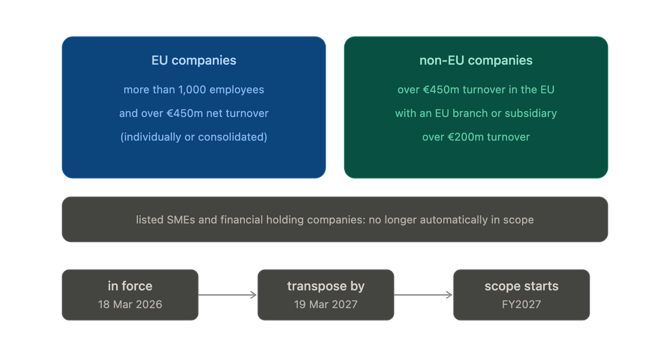
What is the structure of the ESRS and what are its main features?
Double materiality assessment: there are two materiality dimensions to be assessed, namely financial and impact. A sustainability matter is material from a financial perspective if it potentially triggers significant financial effects on the business and may influence its future cash flows and enterprise value. A sustainability issue is material from an impact perspective if it is connected to significant impacts by the business on people or the environment.
Companies will be required to report on those standards, that are material from either dimension or both. Double materiality is the centerpiece of the CSRD, defining the extent of information and areas that need to be disclosed and companies need to clearly define a governance structure to address material topics strategically as well as collect relevant physical and monetary KPI data.
Structure of the standards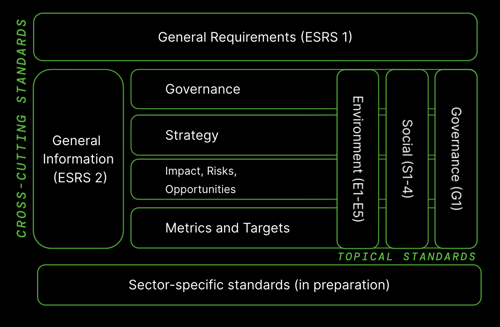
Reporting broadly on sustainability at the same time as financial statements:
One major focus of future compliance is the availability and robustness of sustainability data. An integral part of the management report, sustainability reporting will be published at eye level with financial statements. Further, businesses will be subjected to assurance of their data, requiring clear audit trails as well as process documentations and controls. Non-compliance may lead to fines.
How Cozero supports businesses in championing the CSRD
a. Collaborate to build deep capabilities in carbon accounting and strategic decarbonization
Sustainability reporting will be subject to unprecedented relevance and complexity. For companies, this means building up deep and broad sustainability capabilities in several areas, including carbon emissions. In addition, a large number of internal departments must be involved and sufficient resources must be available.
Cozero enables entire organizations to work together and build a deep understanding of a) company and product emissions and b) how to engage in carbon actions and develop a tailor-made decarbonization journey.
b. An easy way to ensure high-quality climate change reporting
The CSRD places a strong emphasis on data accuracy and quality. Independent quality assurance will not only scrutinize the correctness of disclosed endpoints, it will also take into account the plausibility and robustness of the data collection and calculation methods.
We support our customers throughout the entire process of collecting and entering relevant Corporate and Product Carbon Footprint data, performing quality assurance on the calculations to spot any data shortcomings. Whereas our emission factors and methodologies are based on state-of-the-art research, calculations are executed automatically, guaranteeing accuracy. Lastly, we aim to work on linkages between our platform and the digital tagging system so that our customers can easily cross-disseminate information.
Also, Cozero helps to increase data accuracy through its supplier engagement feature. By collecting supplier data, you can increase the granularity of your Scope 3 emissions calculations and get a holistic picture of your total carbon footprint. Therefore, engaging with suppliers will not only support achieving the best level of data transparency, it also lays the foundation for effective decarbonization management.
Generation of CSRD reports in Cozero
In Cozero, you can track and report your GHG emissions according to specific data ranges and business units or certain guidelines and regulatory requirements.
Currently, the CSRD E1-6 Report and the CDP Report are integrated into Cozero in “Computed Reports”. The feature simplifies the disclosure process and empowers our customers to align with international sustainability standards effortlessly.
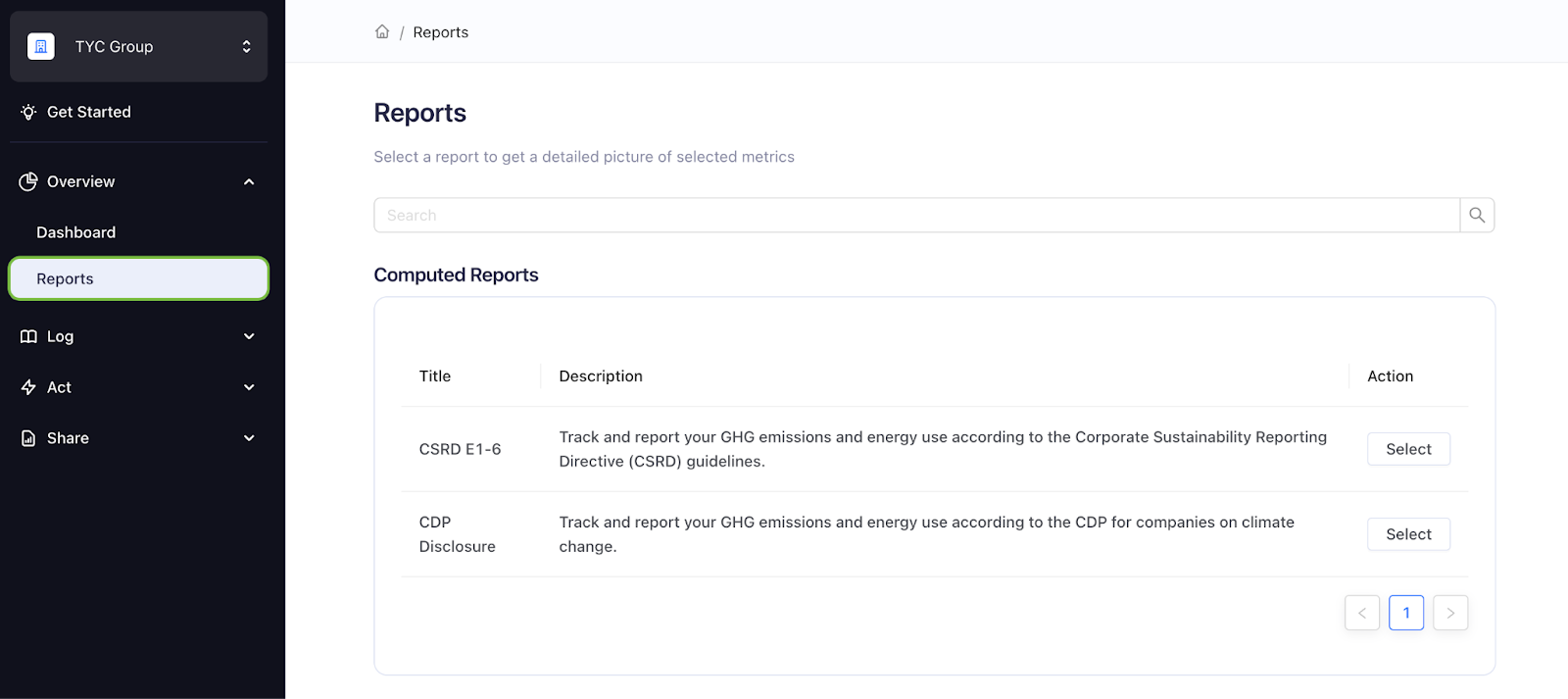
How to use Computed Reports
• Report Name: The title that identifies your report
• Base Year: Set a reference year for the selected Business Unit to compare data and track progress over time.
• Reporting Year: The year for which the organization is compiling and disclosing emissions data, which is compared to the base year to evaluate progress in emissions reduction.
• Business Unit: The organizational unit for which you want to report and track emissions.
Click “Generate Report”. The progress information next to the report name provides details on the current status. While the report is being computed, the field shows “Processing” and switches to “Available”, once the report has been generated.
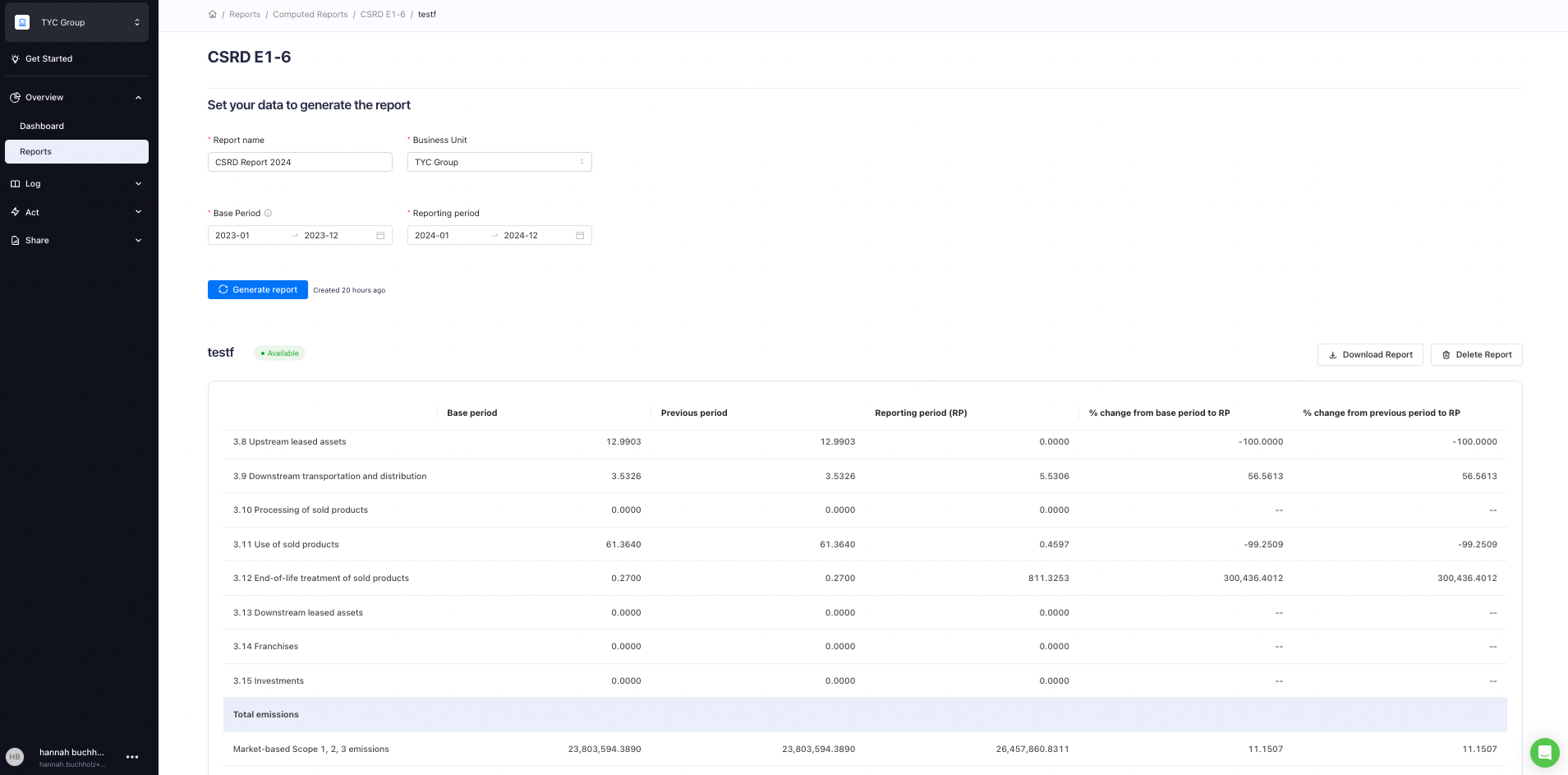
• Download Report: you can save the report as an Excel file to easily share with your relevant stakeholders, facilitating efficient analysis and decision-making.
In the coming months, extensions and additional reports will be available in this section, expanding our coverage of various regulatory frameworks and standards. With this feature, we aim to help you in navigating the evolving landscape of sustainability reporting.
Questions or Feedback
If you have questions about the process, contact us at support@cozero.io.